


Have you ever caught yourself thinking, “I’ll start saving when I have more money” or “Budgeting means I have to give up everything I love”? These are just a couple of the most common financial planning myths that might be keeping you from reaching your financial goals.
But the truth is, these limiting beliefs are holding you back from the financial freedom you desire.
I know this firsthand. Despite my education in financial planning, I graduated college with consumer debt. I started working for small companies that aligned with my values, but they didn’t offer retirement plans with a match. I told myself that I would start saving for retirement later—when it made more sense. But looking back, I wish I had started earlier, even with a small amount. The reality is, financial success isn’t about waiting for the perfect moment—it’s about starting where you are today and staying consistent.
Let’s bust through five of the most common financial planning myths and replace them with the truth that will help you move forward with confidence.
5 Financial Planning Myths:
- Myth #1: I’ll Start Saving Once I Make More Money
- Myth #2: I Have to Take on Debt to Get Ahead
- Myth #3: Investing Is Too Complicated and Too Risky
- Myth #4: Budgeting is Restrictive and Means I Can’t Enjoy Life
- Myth #5: Charitable Giving is Only for the Ultra-Wealthy
Myth #1: I’ll Start Saving Once I Make More Money
One of the biggest financial misconceptions is that you need to earn a higher income before you can start saving or investing. However, the more you earn, the more you’re likely to spend—a phenomenon known as lifestyle creep. Instead of waiting for a bigger paycheck, the key is to start with what you have. Even small, consistent savings add up over time, and compound interest rewards those who begin early.
People who achieve financial freedom aren’t necessarily those with the highest salaries—they are those who consistently save and invest, no matter their income level. The takeaway? Start small, even if it’s $10 or $50 per month – just start today, and let your money work for you.
Myth #2: I Have to Take on Debt to Get Ahead
Debt is often seen as a necessary step to financial progress, but that’s not always the case. While some debt—such as a mortgage or student loans—can be strategic (also known as “good debt” – helping you to invest in something that may be an appreciating asset); high-interest consumer debt (also known as “bad debt”) can be a major burden.
The Bible tells us in Proverbs 22:7 that “the borrower is slave to the lender.” When you rely on credit cards, car loans, or financing for lifestyle upgrades, you limit your ability to use your income in ways that build long-term wealth.
Instead of falling into the debt trap, focus on intentional spending, budgeting, and saving to move forward without financial strain. If you do have debt, prioritize paying off high-interest loans first to free yourself from financial bondage.
Myth #3: Investing Is Too Complicated and Too Risky
Many people believe that investing is too confusing and don’t know where to start, or that investing is only for those who are already financially savvy. But in reality, investing isn’t about having a deep understanding of the stock market—it’s simply about starting early and staying consistent.
Two key financial concepts to understand are inflation and compounding interest. Inflation decreases the purchasing power of your money over time, making investing crucial for maintaining and growing your wealth. Compounding interest allows your money to grow exponentially, especially when you start early.
You don’t need a lot to begin investing. Start with your retirement account or HSA at work since it has a smaller pool of investments to choose from – this can help make it less intimidating. I love low-cost index funds or ETFs – and you only need to start with a small monthly contribution to set you on the path to long-term financial success.
If you’re not sure where to start – grab my free one-page investing cheat sheet. It will reduce the overwhelm so that you can start, because starting is the hardest part. Once you begin and setup simple automations (which can be done in minutes!) – time and compounding interest will do the rest.
Myth #4: Budgeting is Restrictive and Means I Can’t Enjoy Life
Many people avoid budgeting because they see it as a set of restrictions rather than a tool for financial freedom. But a budget isn’t about depriving yourself—it’s about making sure your money aligns with your values and priorities.
When you create a budget that works for you, you’ll find that you actually have more control over your spending, because you have choices. One simple way to shift your mindset is by implementing a purchase pause—waiting at least 48 hours, or up to 2 weeks, before making an unplanned purchase. This helps differentiate between wants and needs, allowing you to spend with intention rather than impulse.
By budgeting wisely, you create space for the things that truly bring you joy, rather than feeling burdened by unnecessary expenses.
There are many great budgeting apps or templates available online. If you’re looking for a place to begin, try our Aligned Spending Method template and see if this works for you. It’s designed to be updated monthly so that you know exactly how much you have each week to hit your goals and spend freely on the things that align with your values and bring you joy, without the guilt.
Myth #5: Charitable Giving is Only for the Ultra-Wealthy
Many believe that generosity is only for those with substantial wealth, but the truth is that giving is about your heart, not the amount.
Jesus praised the widow who gave two small coins because she gave out of faith. Whether it’s tithing, supporting a cause, or helping someone in need, small acts of generosity can make a significant impact.
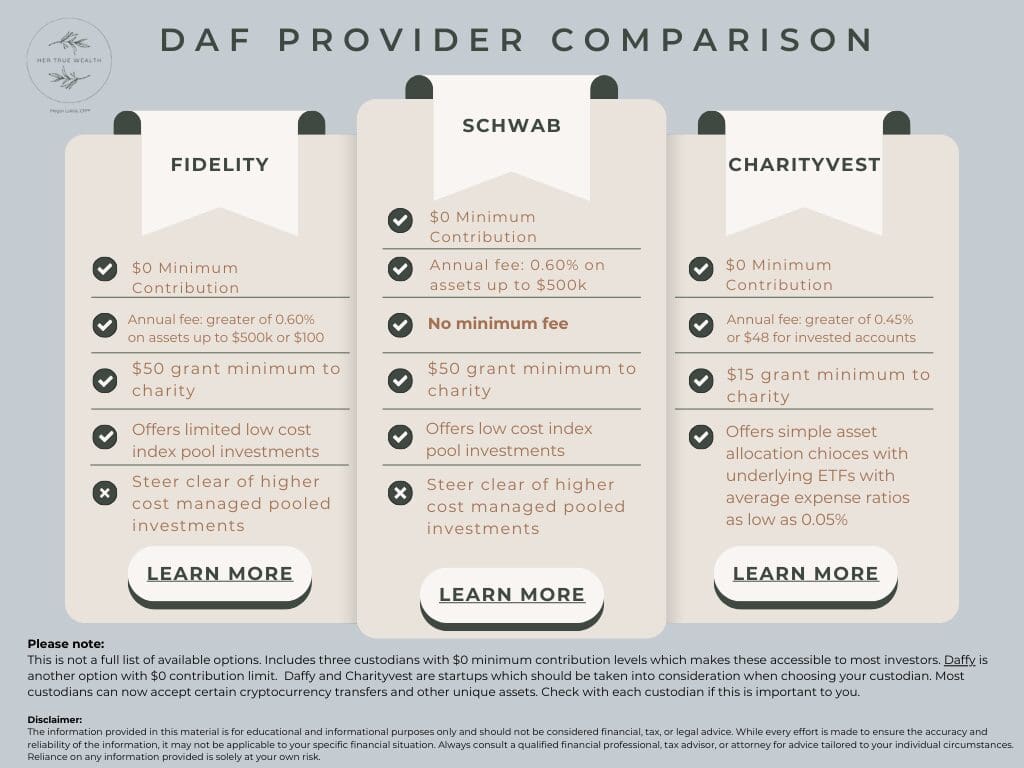
Additionally, tools like donor-advised funds (DAFs) allow you to give strategically and tax-efficiently. If you invest in a brokerage account, you can even donate appreciated assets to maximize your giving while minimizing your tax burden. Many custodians allow you to open this type of account with no minimum contribution amount, which means this is available to anyone, regardless of how much you have.
Giving is a habit that anyone can cultivate, regardless of income level.
If you’re ready to open a Donor Advised Fund, but overwhelmed by where to begin – check out the DAF comparison chart below to help you narrow down a few of my favorite options.
Breaking Free from Financial Planning Myths
When you let go of these financial planning myths and embrace biblical stewardship, you open the door to financial peace and purpose.
If any of these myths resonate with you, take a moment to challenge those beliefs and take one step toward financial freedom. The key isn’t to be perfect—it’s to be intentional.
For practical financial strategies and spiritual encouragement, download our free guide: “Five Simple Steps to Financially Prepare for God’s Calling.“ It’s filled with actionable steps, scripture, and journal prompts to help you align your finances with your faith and values.
Breaking free from financial lies will not only help you find financial peace—it will also allow you to live more fully in God’s purpose for your life. Let’s take that step together.
View comments
+ Leave a comment